Dependency
Entering the Dependency Court System
Juvenile dependency court can have a significant impact on the lives and futures of children and families. In most cases, a dependency case comes to court shortly after a child has been removed from their home by the police or a social worker.
The police or social worker may remove a child from their home if they have a reason to believe the child is not safe, or if there is a credible threat against the safety and well-being of the child.
The court’s authority for dependency cases is found within the California Welfare and Institutions Code. (WIC § 300 et seq.)
When to Appear in Court
If your child has been taken into protective custody, you will be notified to appear in court by a social worker. The social worker will try to contact you in-person or over the telephone and provide you with a date and time to appear at the courthouse.
If your children are taken into protective custody, and you are not aware of the circumstances, you may call the Orangewood Children’s Center for more information.
Dependency Hearings
The circumstances of a dependency case will determine when and which type of dependency hearing will take place. The juvenile dependency court is responsible for ensuring the safety and well-being of children that have been, or are at a significant risk of becoming, abused or neglected. The court’s role is to ensure that the rights of children and their family are protected and exercised in accordance with the law. The court also ensures that the government has performed its duties as appropriate under the law and appoints an attorney to represent each parent/guardian and child.
During these hearings the court will consider several issues related to each case. The court may consider information regarding the severity of allegations, the age of the children, police and social worker reports, medical and psychiatric reports, family history, kinship (relatives), and oral arguments from attorneys. Attorneys are appointed by the court for each child and parent/guardian for each case. Testimony may be heard from people such as social worker(s), police officers, parents, family members, doctors, teachers, witnesses, and in some cases by the child(ren).
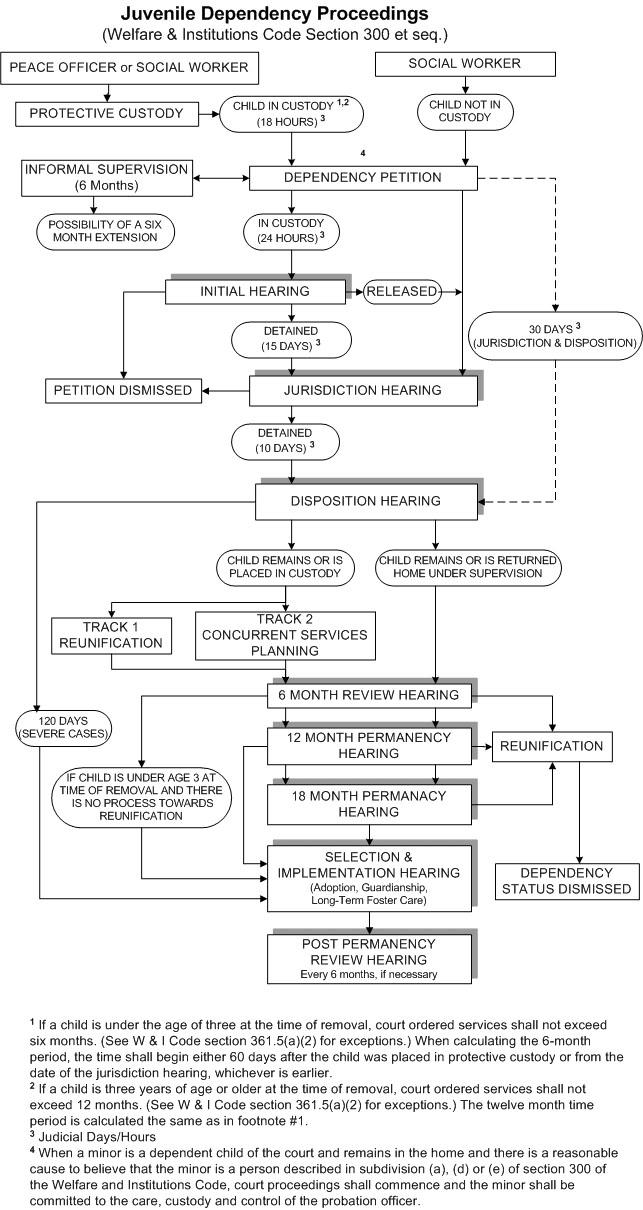
The following chart illustrates the process and related time-frames of dependency hearings:
INITIAL HEARING / DETENTION HEARING:
Dependency court hearings are initiated when the Social Services Agency files a petition with the court. The petition identifies the child(ren) and parent(s) involved with the case, and describes the allegations of abuse or neglect against the child(ren). The court clerk files the petition and assigns the case to a courtroom for an initial hearing. The initial hearing is also called a "detention hearing" if a child has been taken from their home and placed into protective custody.
The following actions occur at the detention hearing:
- The court gives the parents a notice about what is happening (the "proceedings").
- The parents get a copy of the petition and any other documents for the case.
- The court tells the parents what can happen in a dependency case.
- The lawyers for all sides (called "parties") introduce themselves to the court.
- The court writes down the names of the child(ren)’s relatives, if possible.
- If possible, the court confirms who the parents of the child(ren) are; also called "parentage."
- The court decides if the child(ren) should stay with a parent(s) or live somewhere else until further proceedings take place.
If the court places a child away from a parent, the court may make visitation orders so the parent(s) can see the child(ren). The court will also tell the parent(s) where they can get help so the child(ren) can be returned into their custody.
The court also decides if the Social Service’s Agency made a "reasonable effort" to keep the child(ren) with the parents.
JURISDICTIONAL HEARING:
At the jurisdictional hearing the court decides if what the petition alleges is true. The court has three ways to do this:
- The parent(s)/guardian(s) admit the petition is true.
- The parent(s)/guardian(s) do not disagree with the petition (called "submission").
- The parent(s)/guardian(s) dispute, or contest the petition. Both sides give the court evidence at a hearing. Then, the court finds the petition to be true or not.
Before the judge accepts an admission or submission, the court has to be sure the parent(s)/guardian(s) want to "waive" (give up) their right to a trial. This means the parent(s)/guardian(s) are giving up the right to see, hear and question witnesses, and to bring in their own witnesses, testify, or choose to remain silent.
DISPOSITIONAL HEARING:
If the court decides the petition is true, it will say what should happen with the child(ren). The judge can:
- Dismiss the case.
- Let the child(ren) live with a parent(s)/guardian(s) on a "family maintenance" program. This means that a social worker and the court supervise the child(ren) while under the care of a parent(s)/guardian(s).
- Take the child(ren) away from the parent(s)/guardian(s) and send the child(ren) to live with a relative, foster parent(s) or group home and offer the parent(s)/guardian(s) family reunification services.
- Take the child(ren) away from the parents/guardian(s) and not offer family reunification services to get their child(ren) back. If this occurs, there will be a hearing within 120 days to decide where the child(ren) will live permanently ("permanent plan").
The court may not let the parent(s)/guardian(s) try family reunification services if:
- The brother or sister of a child has been seriously abused or killed.
- The parent(s)/guardian(s) had another child taken away by the court.
- The parent(s)/guardian(s) tried family reunification services in the past and they were canceled.
- The parent(s)/guardian(s) have serious drug or psychiatric problems that are not being treated.
- There are other reasons the court may not order family reunification services and order an alternate permanency plan for the child(ren).
SIX-MONTH REVIEW:
This hearing lets the court see:
- How the child(ren) is doing, and
- How the parent(s)/guardian(s) is doing with the services the court ordered.
If the child(ren) lives with a parent or guardian, the court can:
- Dismiss the case, or
- Keep supervising the child(ren) with family maintenance.
If the child(ren) does not live at home, the court can
- Give the child(ren) back to a parent(s)/guardian(s). The family will stay with family maintenance, or
- Keep the child(ren) out of the house and order family reunification services.
However, if the child(ren) was under three years old when the court took them away from the parent(s)/guardian(s), the court can stop family reunification services. This happens if the parent(s)/guardian(s) do not participate or exhibit appropriate progress in treatment programs.
12-MONTH REVIEW:
At this hearing the court decides if the child(ren) will return to the custody of their parent(s)/guardian(s). If not, the court will cancel the services so the child(ren) can receive a permanent plan. The court will set a hearing to decide a permanency plan for the child(ren).
The court can let the family reunification services continue for another six months if there is a good chance that the child(ren) will return to the custody of their parent(s)/guardian(s).
18-MONTH REVIEW:
At this hearing, the court decides if the child(ren) will go back to the parent(s)/guardian(s). If not, the judge will cancel family reunification services. The court will have a hearing to decide a permanent plan for the child(ren).
FAMILY MAINTENANCE REVIEW:
The court may have this hearing to:
- Check up on the child(ren),
- To see how the social worker is working with the family, or
- To see how the parent(s) are doing with their case plan.
SELECTION & IMPLEMENTATION ( WIC § 366.26 HEARING):
At this hearing, the court makes a permanent plan for the child(ren). The plan(s) can:
- End parental rights so the child(ren) can be adopted,
- Name a legal guardian for the child(ren), or
- Place the child(ren) with a relative, foster parent, or in a group home for an extended period of time.
If parental rights are terminated, the court’s preferred choice for a child’s permanent plan is adoption; with an alternative being legal guardianship. Another option for a permanent plan is a long-term placement, however this is the least likely choice to give the child a permanent home.
POST-PERMANENCY PLANNING HEARING:
This hearing determines if progress is being made to find a permanent home for the child(ren) and if the case can be dismissed. This type of hearing can occur every six months until the case is dismissed.
Additional Resources
- Orange County Social Services Agency Dependency Court Video (English)
- Orange County Social Services Agency Dependency Court Video (Spanish)
- Kids and the Law: An A-Z Guide for Parents provided by the California Bar Association (English and Spanish versions available)